I don’t know exactly when it hit me. Maybe it was in middle school, the first time I saw my mom cry over something that had nothing to do with me. Or maybe it was when I became a mother myself—overwhelmed by the weight of responsibility—and wondered, Did my parents feel this lost too?
For most of childhood, our parents feel like these all-knowing, put-together forces. They tell us what to do, how to be, what’s best. They are the ones with the answers, the rules, the discipline. And we assume they get it. Until one day, we realize… they didn’t. They were just figuring it out too.
I think about my mom, who wasn’t overly affectionate in the traditional sense but showed love in ways I didn’t always recognize. She was there at every event, made sure I had everything I needed, and used her quick wit and sarcasm to connect, even if I didn’t always understand that as love. But the day I saw her cry, really cry, was the first time I realized she wasn’t just Mom. She was a woman with her own struggles, her own grief, her own pain that had nothing to do with me. That moment shifted something in me. She wasn’t just the strong, resilient force I had always seen—she was human.
Then there’s my biological father. His battle with addiction meant his presence in my life was inconsistent, and for a long time, I struggled with that. I wanted him to be more, to show up in ways he couldn’t. But in the end, I saw his heart. I saw the love that was real, even if it wasn’t steady. I saw a man who, in his final years, found peace in his faith. That matters to me now more than the gaps in between. I used to carry anger, but now, I carry grace. Because I understand that love, even when imperfect, is still love.
And then, my dad—the one who raised me, who was there for the everyday moments. He is mild-mannered until he’s not, a man of quiet strength. When he returned from Iraq, he expected to come home. Not just to the house itself, but to the familiar—to the safety net, to normalcy. But life had moved forward without him. His kids had changed, his wife had changed, the world had changed. And for the first time, he realized that while he had been at war, we had been too—just in a different way.
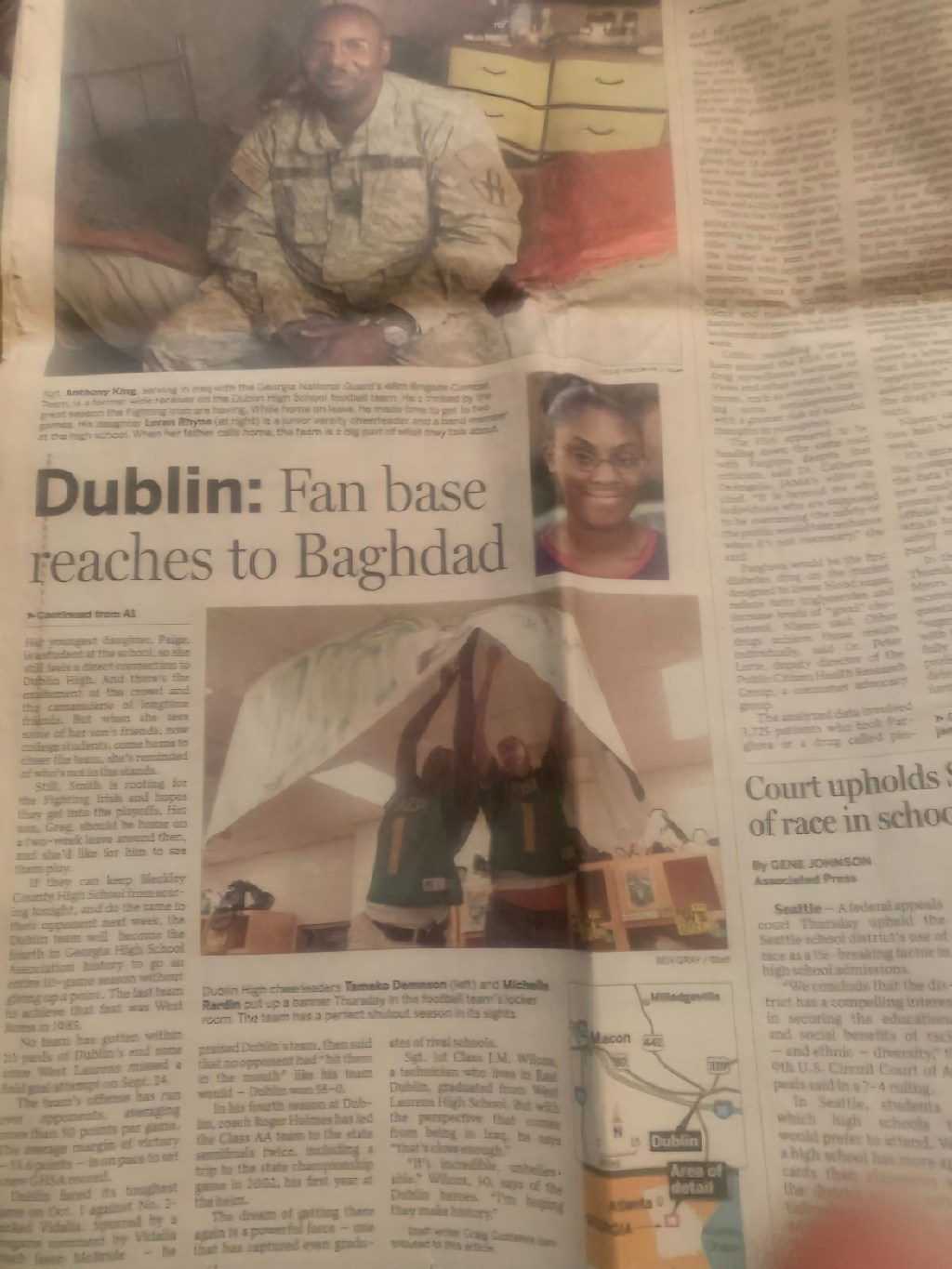
I was a teenager when he came back, and I was angry that he was so angry. We clashed, often. What I didn’t understand then, but I do now, is that he was battling PTSD. He was afraid and trying to figure out where he fit in the life that had evolved in his absence. He was surviving, just like the rest of us. I remember when he and I were featured in the Atlanta Journal-Constitution during his deployment. The article highlighted Dublin High School’s winning streak that year and the athletes with family members serving overseas. That moment should have been purely celebratory, but in hindsight, I realize how much of our story was woven into that season—victories on the field, battles at home, and the weight of war, both seen and unseen.

Becoming a mother has softened some of my frustrations, but it’s also made me grieve. Grieve for the moments I didn’t get, for the things I wish had been different. But in that grief, there’s also grace—the kind I hope my daughter will one day extend to me when she realizes I was just a person too.
There was a time when I would have been embarrassed about certain things that had happened to me—the choices I made, the struggles I faced, the moments I wish I could rewrite. But then I remember the prayer I once prayed: Lord, use me as You see fit. I told Him not to waste anything in my life.
And He hasn’t.
Every joy, every heartbreak, every lesson—He has woven it all together for a greater purpose. So I choose to share, to be open, to let my story be used for something bigger than me. Because if even one person finds healing, hope, or understanding through my experiences, then it was never in vain.
Now, I want to hear from you. When was the moment you realized your parents were just people? The moment you saw them, not as superheroes or rule-makers, but as human—flawed, struggling, learning as they go? Share your story in the comments. Let’s have this conversation together.
Until next time,
Keep Living!
Love, Loren



 Living with Loren
Leave a reply to D. King Cancel reply